Before the 1980s, educators were still largely unaware of what we now know as ADHD. The condition first appeared in the Diagnostic and Statistical Manual (DSM) in 1968, which began bringing ADHD to the attention of those within the education system. The DSM is a publication that includes description of cognitive disorders lists of symptoms, and criteria for assessment and diagnosis. Educators typically observe wandering attention, and instances of getting sidetracked before completing tasks. These behaviors are sometimes labeled by educators as “daydreaming.”
These signs were evident to teachers before psychology provided a label and an explanation. They were treated in classrooms with admonitions to “pay attention” or “stop daydreaming.” Beyond these scoldings, and calls expressing concern to parents, often there was no helpful treatment offered other than placing students in lower achieving groups. I should know. I was one of those students. As I reflect on my experiences in school, and my current tendencies, I’m convinced I’m ADHD. In this article, I’d like to reflect on what realizing that has meant to me, and what I’ve learned about myself and how I best function. My reflection does not have any psychiatric or medical authority behind it. It is just what I’ve observed about myself.
I function with basically two interactive tendencies. They are a short attention span, and a strong desire to complete what I’m having trouble keeping my attention on. I have very focused, strong attention on what I’m doing, but only for short periods of time, but when I leave off from what I’m doing, I immediately feel compelled to resume doing it, being restless to complete it.
The way these two things interact is of the utmost importance. When I exit a task, it is not, and cannot be, giving up on it. There is not a feeling of “I give up, I can’t do this.” Quite the contrary, there is a feeling of “I will not give up on this, I just can’t keep at it right now. I’ll get back to it as many times as necessary until I finish it.” Do you see the critical difference? If what I’m doing is something in a classroom, I may run out of time. I may not be given the opportunity to keep going back to it. The window closes, the task is unfinished, and I’m left feeling unsettled about it, while my teacher believes I simply can’t do what is being asked of me. My need for more time is mistaken for inability to succeed at all.

I enjoy reading novels. But novels are long books. Many are three or four hundred pages. Here’s how I read them. Lots of short sessions. I’ll read 20-40 pages, then set the book down, go do something else, then come back to it and read another 20-40 pages. By the end of the day I’ve read close to eighty pages. But I’d never read eighty pages all at once.
I’m a clarinetist. I do the same thing with my practice. Twenty minutes at a time, do other things in between. On days I try to do my practice all at once, I’ll practice about thirty minutes and that’s it. On days I do twenty minute sessions, I’ve already practiced more after just two sessions, and frequently do three. Two days ago, I practiced for twenty-five minutes, watched the first period of a hockey game on television, practiced twenty minutes during the first intermission, watched the second period, then practiced twenty minutes during the second intermission. That’s over one hour of practice compared to half that if I tried doing it all at once.
So how do I handle a two-hour band rehearsal? Actually, long rehearsals are right up my alley. I play, I stop playing and listen to what the conductor has to say to me or my section, I play again, I stop playing and listen to what the conductor has to say to others. I play again, but only with part of the band. I don’t play, but listen to other sections play. Then I play again with something new to listen to that the conductor has just worked on with others or with my section. When I’m conducting, it’s even easier. There’s so much to attend to, I’m never challenged to keep my attention on one thing over a sustained period of time. In fact, I switch between focuses of attention so fast, it can be hard for the band to keep up. But it suits me well. Perhaps this is why students who struggle academically often do well in music. It’s the only classroom where their ADHD behavior is given a learning environment where it can thrive and be an asset instead of a liability.
But there’s a caution flag for music teachers. Don’t drill down for extended periods of time on one thing. Drilling the same passage until it’s right is not a good strategy for me. Not if it’s the same thing repeatedly. Learning a passage of sixteenth notes by simply repeating it quickly has diminishing returns. Drilling that passage but with a different articulation pattern each time gives me enough variety so I can keep at it much longer. The key is repetition for short intervals, or repetition with variations for longer intervals.
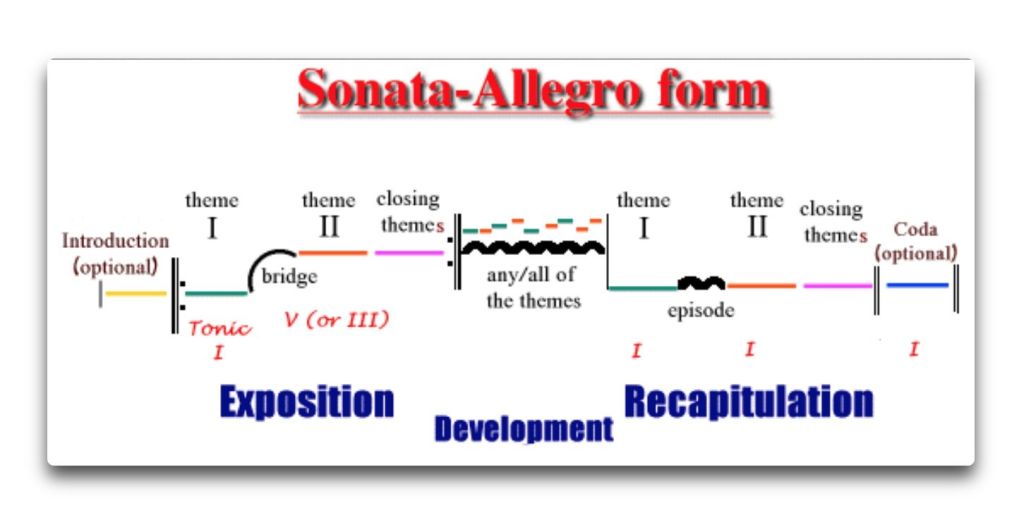
I think this is why I have liked classical music for as long as I can remember. Popular music is repetitive. I quickly loose interest in a song once I’ve heard all the sections once. My favorite popular songs are the ones with the most variety. Classical music has a balance between repetition and variety that is usually just right (except for minimalism—more on that momentarily). It keeps my interest because it is constantly changing, evolving. Another trait of the ADHD brain is that it is really good at pattern recognition. Tracking a motif through its many developments and changes is fun and satisfying. I suppose that is why I prefer movements in sonata-allegro form to a rondo. There’s metamorphosis in the sonata-allegro movement, whereas there is just, or mostly, repetition in a rondo. The rondo doesn’t hold my interest for the same reason a popular song doesn’t. And yet, what do music teachers, especially Orff teachers, use incessantly? Rondos. It’s easy to teach structure with a rondo, but to my brain, it’s boring. I’d much rather improvise variations.
So when students are having a hard time keeping focus, it may be that they are a lot like me. Keep the engagement time short, but keep returning to the task, with some variety in between. Structuring learning like a rondo is helpful. A is the learning task. B is a different learning task. A, if it’s a repeat of the first A might be okay, or maybe it needs to be A prime. That’s the variety that learner needs. And above all, do not mistake loss of focus with inability to succeed. The path to success is different, longer, not a straight line, but it’s there, and it’s your job as a teacher to make sure it’s open.

