
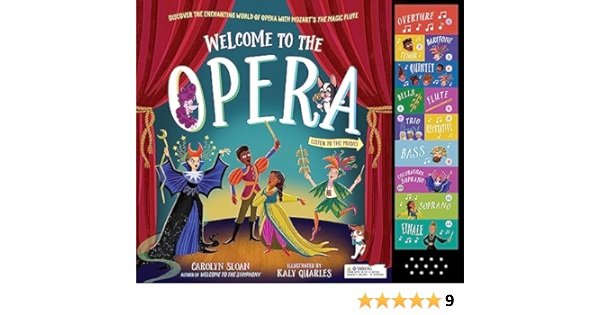
I recently read Carolyn Sloan’s excellent volume, Welcome To The Opera. In this article, I will share my running notes that I made as I read the book, and then my summative review. This is a welcome addition to previous books by this author introducing children to other music forms. It can be difficult to find materials for children that are easily understood, comprehensive, attention grabbing, and so effectively interactive. This book is all of that. Ms. Sloan clearly not only has a firm grasp of the material, but also knows how to expertly present it to children and in a form that adults can enjoy sharing with their children or students.
Welcome page.
- what is a symphony? What is a concerto?
- Mozart died after he wrote this story? That’s sad.
- I like the meeting in the lobby before the opera begins. Families and friends together, excited about what they are about to experience.
Arrived in our box.
- The excitement is still there. This is what it looks like inside an opera theater.
- Vocabulary and background notes are concise. The layout is much like an interactive website. So far, this would make a good e-book.
Orchestra and Overture
- Why is it called a pit?
- Care has been taken to represent diversity in the orchestra.
- Concert etiquette is nicely worked in.
- The ability to listen to sound samples is good. It took me a few minutes to figure out that the player needed to be turned on. Eliminating the switch and having the music play right away when the number is pressed, and then having auto shut off would be better.
The dragon
- This is how kids would react to seeing the dragon.
- The storyline is being kept very simple.
Meeting Papageno.
- I like that the characters are recognizable by their voice type and by their costume.
- If this book is read to a child, then they could ask what else they would like to know about the picture on this page. For example, what are those tubes he is wearing around his neck? Why does he have a cage?
The set
- The lesson here is patience. Wait for your questions to be answered in the story instead of talking about them during the opera.
- So is the Queen good or evil? Is the King good? The queen kind of looks like the witch in Snow White. She must be bad.
The Bells
- It is helpful that the story line is always at the top of pages in a blue banner, vocabulary is always in yellow boxes, and dialogue from our animal guides are in white balloons.
- Singing in harmony does not require that all voices be singing the same rhythm, though they are doing so in this example.
- Though they are not evil, it looks like the three ladies are because they are dressed in black, like the Queen.
Trio
- The puppy wasn’t paying attention. In a Singspiel, and we already know this is one of them, there is also talking. Still, recitative is different from talking, and that is the point of this page.
- We finally learn that the King is good and the Queen is evil.
- The convention of the villain being a bass is not followed here, and that exception is handled very well. If the bass is not the villain then who is? Is a great approach. In this opera, the soprano is the villain.
Pamina
- I love this: “her glorious voice helps the audience feel what she’s feeling: frightened and lonely.”
- Good reminder not to talk during the performance.
- Pamina is also a soprano, but sounds different than the Queen. This is well explained. How is Pamina’s voice different from the Queen’s?
Finale
- Looks like a happy ending.
- Wait, how did our animal guides get down to the stage? Where are the ushers to prevent this?
Last page spread
- Bravo!
Comments:
- Recommended for ages 9 and older.
- Recommended for having it read to children by a music teacher or knowledgable parent
- Would make an excellent interactive e-book or website.
Review
Welcome To The Opera is an entertaining yet informative text and audio file package. It packs plenty of information about many facets of the art form into a storybook format. The illustrations are pleasing and informative, and the text is well organized so that the material presented can be easily understood. For example, all storyline entries are in a blue banner at the top of pages, vocabulary is in yellow boxes, and the dialogue of our companions at the opera, a cute family of puppies, is always in comic book-like speech balloons. The puppies speak a child’s point of view to the point where we can easily believe we are really there at the opera in the audience with them. Vocabulary and concepts are further illustrated by sound files which are played by pressing on the designated number on the player which is conveniently attached to the book to the right of the text. The author’s approach to opera as storytelling through song is one that immediately appeals to children. They love being told stories, and they love to sing, so the authors are offering something that is naturally appealing to children. The vocabulary is on a 5th or 6th grade reading level. The text is wonderfully suited to younger children if an adult reads it to them.
 mister a music place