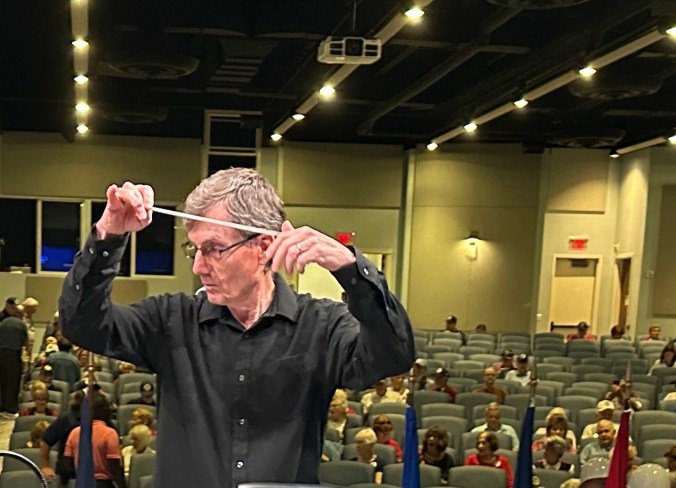
At some point in my music teaching career, later than it might have been, I questioned why I was putting so much physical effort into conducting my band, and getting a very poor return on my investment. As my band dragged the tempo, I pumped the beat harder. As they ignored dynamic markings, I got bigger than my frame could support, or so small no one could see what I was doing. All of this work–hard work–and they were still playing too slow, or too loud, or too soft. What’s worse, while I was making all of these fruitless gestures, I was distracting myself from the very. important matter of playing musical, and of developing musicians out of players. Players know the executive skills needed for playing an instrument, but they cannot make interpretive, expressive decisions. And there was no one to teach them these important things as long as I was obsessed on gyrating from the podium just to get the tempo and dynamics I wanted at any given moment. It was a lot of well intentioned but misdirected work, making conducting a lot harder and less effective than it should have been.
Then I watched Karl Bohm conduct the overture to Mozart’s The Magic Flute. His baton never ventured outside of a one foot square, and he never ventured out of his chair. At first I thought he was just not doing what conductors are supposed to do. But the orchestra was playing expressively, so I looked
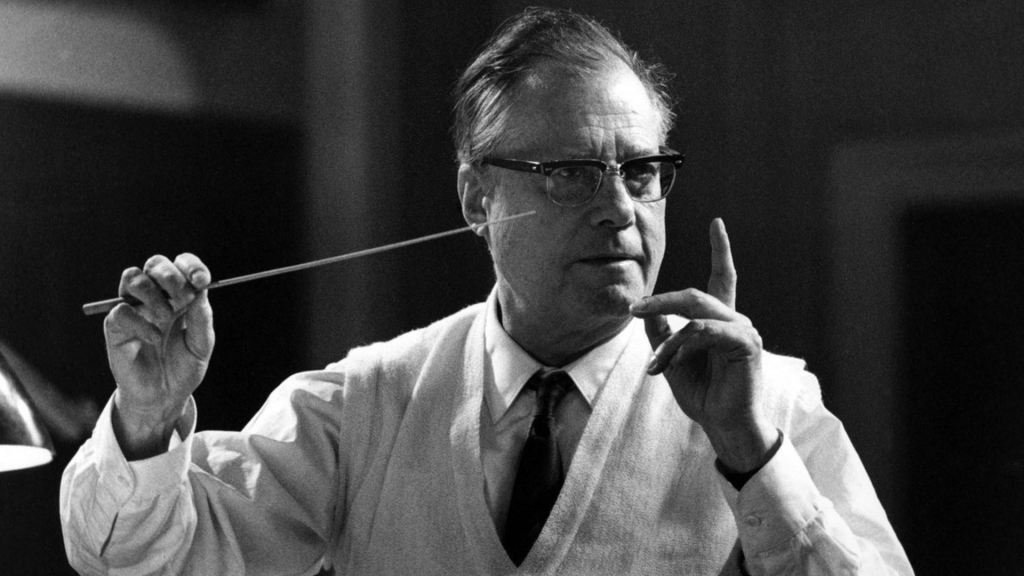
closer. Then I saw it. Within that small space in which he was working, there were lots of small, subtle but expressive gestures, and the the orchestra was picking them up. I then started watching Bohm’s baton as carefully as I could, and a whole world of expressiveness could be found there. I had come of age idolizing Leonard Bernstein, Young People’s Concerts and all, so I had no idea a conductor could get that much out of an orchestra with so little physical exertion. I was fascinated and motivated to explore this new (to me) way of conducting.
How I Turned That Lesson Into Action
I went home that day and tried an experiment. I set two books upright on my desk, and laid a third horizontally across the top of the other two, forming a square. I got my conducting baton, and began conducting with the tip of my baton inside the three stacked books. I conducted legato, staccato, loud and soft. After knocking into the books several times, I began to get the knack, and soon I was able to see expressive gestures within that small space.
I was assistant conductor of a community band at the time, so at the next rehearsal, I began trying out my new technique on them. I soon learned that when the norm is less, when I did more, it got a bigger response. Keeping everything within that imaginary one foot square, and only coming out of it for a forte-piano, I got a much better forte-piano, because the contrast between the norm and that gesture was greater and so more noticeable. More expressive with less physicality. Lesson one learned.
There was one part of my admiration for Bernstein that was helpful at this point. While I no longer wanted to jump around and wave my arms wildly, I wondered what would happen if I used my face, and even the rest of my body to supplement or even at times replace what my arms were doing. This time, I decided to try facial expressions out on my middle school band. They may not be very good at changing dynamics or keeping the tempo constant, but they sure would notice if my button down collar wasn’t buttoned, or (yes this really happened) if I still had a trace of mascara on from my theater performance the previous night. It turns out, middle schoolers love to see their band director make faces at them, and they delighted in playing what my face directed. Add a little bounce from the knees for a lilting folk tune, and my conducting make-over was well on its way.
How My Action Point Empowered My Students
There’s another benefit to this more minimalistic approach to conducting, and that is this: the musicians feel less controlled and more free to make artistic decisions. Part of the reason I wasn’t getting expressive playing from them was because I had taught them, intentionally or not, to only do what I told them to do. By conducting in such an emphatic, boisterous way, I had wrestled much of their musical freedom away from them. It’s true, I needed to do better teaching them how to make artistic choices, but I also needed to leave them room to do so–to create an environment in which they were free to try out their own ideas, and operate as collaborators. Lesson two learned.
From there, I instituted a policy that was as much for me as it was for them. We wouldn’t play any piece in a concert that they couldn’t play without a conductor by the dress rehearsal. That put the onus on me to teach them musicianship and independence, and it but one onus on them to more carefully prepare their parts, and think through how they were going to play. Suddenly, more and more students were practicing passages from the music they were about to play instead of talking to their friends. The students became more motivated, and their playing quickly improved.
Conducting That Is Really Conducting
Now, years later, I am affiliated with another community band. When I conduct them, I often conduct with little or no arm motion, using only my face and body. They immediately know that I am releasing them to take the reins within the boundaries of the decisions we have already made as to how the piece will be played. When I do gesture, it is often for something not printed on the page; some nuance that brings out the composer’s overall intent. Having the band play what’s written so I can conduct what isn’t written brings the performance to the next higher level, and brings a wonderfully freeing feeling to the band and to me. It elevates conducting to the art it is meant to be, above the drudgery of basic timekeeping, This is a case of not only “less is more,” but also of less creates more. If you’ve been banging those arms in the air, obsessing over tempo and dynamics, I encourage you to pull back. Empower your musicians by entering into the music with them, instead of battling with it.
 mister a music place