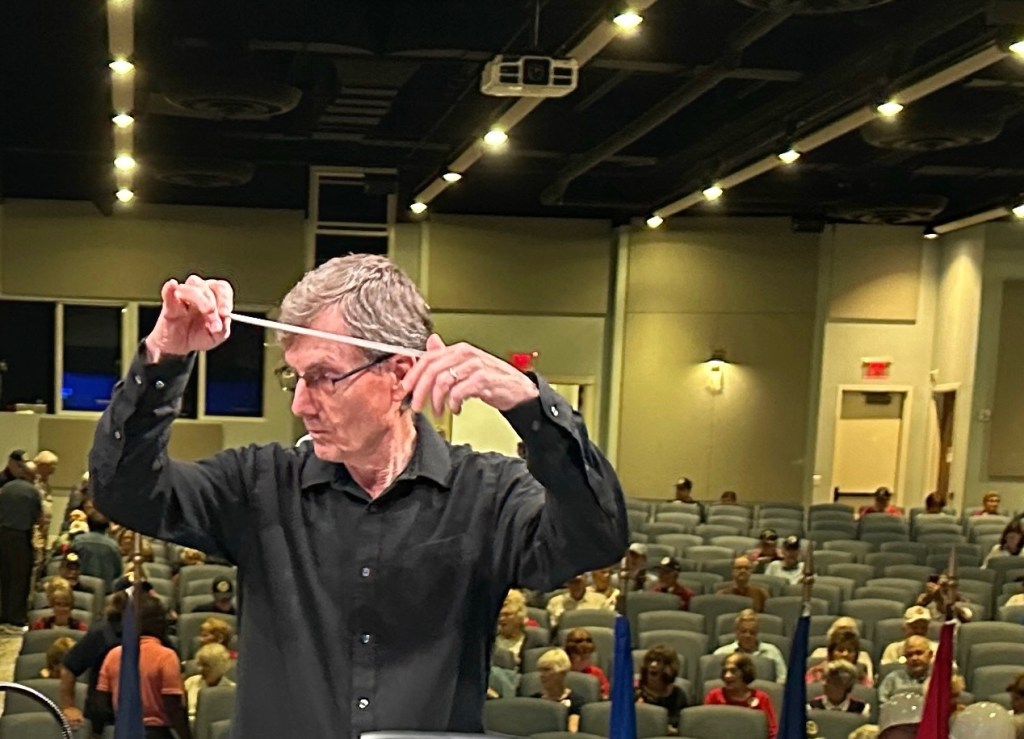
I wrote my first music composition for concert band when I was in high school. I was fortunate enough to have a supportive band director who allowed me to pass out the parts I’d made, and read the piece with our concert band. Eventually, I got a pretty good reading and a pretty good sense of how my piece sounded. But it was hard work getting it played the way I’d written it. The reason it was such hard work was that my hand-written parts were hard to read. They were done in pencil, and certainly could have been notated better. But because they weren’t I spent a lot of my time explaining what the notes were, and as a result had a lot less time to actually hear my music.
I never forgot that lesson. I continued to compose and had several pieces performed when I was in college. But I always made sure that the musicians would not have to struggle with my notation to play my music. It might be challenging in its difficulty or complexity, but the notation would be instantly readable and understandable.
Music Notation Software
With the advent of music notation software, the issue of poor penmanship was eliminated, but not all of the unnecessary hindrances to clear music notation have been removed. I’m not talking about custom notation where various shape notepads are used, or other than five-line staves are the composer’s choice. Those unconventional practices are necessary in order to adapt our system of musical notation to demands not existent when our system of writing down notes was developed hundreds of years ago. I am talking about insisting on continuing conventions that are no longer necessary and which impede the efficient reading of parts and scores. For example, when all parts were handwritten, key signatures, and even clefs, were sometimes omitted after the first line. This made sense for handwritten parts, because it saved time and space. More music could be fit on a staff it space wasn’t taken up by repeating key signatures. And in pieces where there is only one key signature, it’s not difficult to remember what key you’re playing or singing in. But I’ve seen composers and engravers (using software, though the term “engraving” still is used) leave key signatures out after the first line in parts for pit orchestras of Broadway musicals, where key changes are common and frequent. Playing these shows is difficult enough already, without having the copyist/engraver make it even more so for no reason other than “because that’s the way we’ve always done it.”
Another example of this sort of thing is how notes are beamed. Music notation is easiest to read when notes are beamed in such a way that beams always start on a beat. Doing this makes the organization of the measure instantly apparent, and makes stopping to figure out where everything belongs in and within the main ictuses. For example, when an eighth rest occurs on a beat and is followed by three eighth notes, it is easier to read the rhythm if the first eighth note has its own flag, and the remaining two are beamed together. That way, it is clear that the next beat begins on the first beamed eighth note, and the figure cannot be confused with a triplet. A related issue is to always plays the number three above a triplet, or whatever belongs above other tuplets. Beginning beams on beats becomes even more essential when durations smaller than an eighth note are used. It’s simply frustrating to have to count out a string of thirty-second notes to find where the beats and half beats are when everything is beamed together. Inaccuracies in rehearsals result, which brings the quality of performance down, and which makes rehearsals unnecessarily long.
There’s Often More Than One Way

Another area where problems are apt to creep in are when “mixed meters” are used. There is nothing objectionable about using mixed meters; I like and enjoy them, both as a listener and a performer. But these meters are commonly called “mixed” for a reason. They mix duple and triple rhythm patterns together in the same measure. And example is 5/8 meter, which mixes a duple rhythm with a triple rhythm. But which comes first. Is it 2 + 3, or 3 + 2? Mixed meters that have more than a pair of rhythmic beats have more possibilities. In 7/8 meter, a composer might want 2 + 2 + 3, 2 + 3 + 2, or 2 + 2 + 3. there are even more possibilities if a single eighth note is left un-bared. But composers or engravers don’t always make it clear which grouping is desired. Many times it is evident, but not always. And sometimes, the meters and beaming of notes within measures doesn’t always seem to best represent what the music is supposed to sound like, or how the music could be notated most clearly. I remember conducting Cajun Folk Songs with my concert band. The changing mixed meters were a challenge to them until I changed the printed meters and how notes were bared together. I did not in any way change the way the music sounded, but my re-notating made the music more playable for my students.
Consider Who’s Reading
If you notate music for others to perform, consider who is going to be reading your rendering. Just because Wagner wrote bass clarinet parts in bass clef doesn’t mean it’s a good idea to do that today, for any clarinetist, student or professional. Just because Brahms wrote the first movement of his third symphony in 6/4 meters, with dotted whole notes all over the place, it doesn’t mean you should write music for amateur ensembles in that meter. They’ll be much more comfortable with 6/8 or twice as many measures in 3/4. I’m pretty sure, if you don’t already know that the Brahms movement is in 6/4, you’d never guess it wasn’t in 6/8. Like many things in life, just because you can doesn’t mean you should. Just because Mahler did it that way, doesn’t mean today’s musicians will appreciate you doing it that way. It’s in your best interest to make your music as readable and understandable as possible. Then, even if it’s difficult music, at least the notation won’t hold the ensemble back from giving it the best possible performance.
 mister a music place