
For a non-percussionist teaching middle school or high school band, deciding what kind of mallets to use on various instruments, in various compositions, and for various effects can be confusing. The choice of mallet type and hardness has a profound effect on not only the loudness of the tone produced, but also of the timbre and duration of notes. Let’s begin by considering hardness.
Different hardnesses of mallets will produce different overtone preferences. Generally, harder mallets produce a brighter sound, preferencing higher overtones, and softer mallets will produce a darker sound, preferencing lower overtones. The softer mallet dampens the higher overtones, leaving the darker lower ones to be heard more prominently.
When a forte or louder dynamic is desired, harder mallets are generally used. Not only does this provide more volume, but because of the emphasis on higher overtones, the sound tends to “cut through” and ensemble more easily. But the harder mallets also produce a colder sound, and produce a clicking sound that may not be wanted. Harder mallets also wear on the instruments they are played on more than softer ones, so frequently choosing hard mallets will shorten the service of instruments and create intonation problems from the gradual damage caused.
To avoid these consequences, it may be desirable to avoid using brass mallets on instruments made from aluminum, and instead choose aluminum or hard plastic mallets. A good rule of thumb is that the mallet should never be harder than the bar of the instrument being played with it. So if you have a rosewood xylophone, use plastic mallets, and not metal.
Varieties of Mallets
Mallets vary in four important ways: core material, weight, head shape and size, and wrap. Mallet heads have a core that may or may not be covered with a wrapping. The composition of the core can determine the sound produced, and is a separate consideration from the hardness. Two popular core materials are rubber and plastic. Plastic cores tend to produce a bright, clear attack with more staccato, and rubber cores tend to produce a warmer, more balanced attack with less staccato.
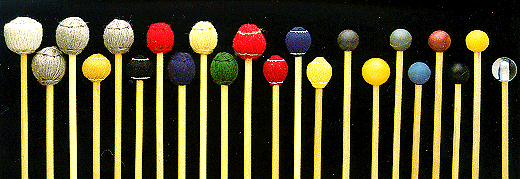
Unwrapped mallet cores can be plastic, rubber, wood or metal. Rubber is the softest core material, wood is harder but warmer, and metal is extremely hard and, for reasons mentioned above, should be reserved for steel instruments.
A mallet’s weight contributes to the fullness of sound made. Lighter sticks produce a delicate legato well suited for solos. Heavier mallets produce a full, bold sound that is useful for ensemble work. Heavier mallets also are capable of louder dynamics while maintaining the integrity of the timbre.
The weight of a mallet is primarily result of the material used for the core, but sometimes additional weights are added to cores made from lighter materials to enable them to be played louder. Because heavier mallets require more effort to lift, staccato becomes increasingly harder to achieve as mallets get heavier, and there is a risk of injury from the repeated strain of using heavy mallets.
The shape of the mallet head effects how much of it comes in contact with the bar of the instrument, which in turn effects the tone made. The more of the mallet that contacts the instruments, the more subtle the attack, and less head contacting the instrument results in a more heavily articulated attack. The three basic shapes for mallet heads are ball, barrel, or disc. For different size mallets with the same shaped heads, larger heads will achieve more contact with the instrument. The shapes are the same, whether the heads are wrapped or unwrapped.
The most used mallet head shape is the ball. This is used for marimba and vibraphone, and is a good all-purpose shape. Where a more pointed sound is desired, disc-shaped mallets are a good choice. They
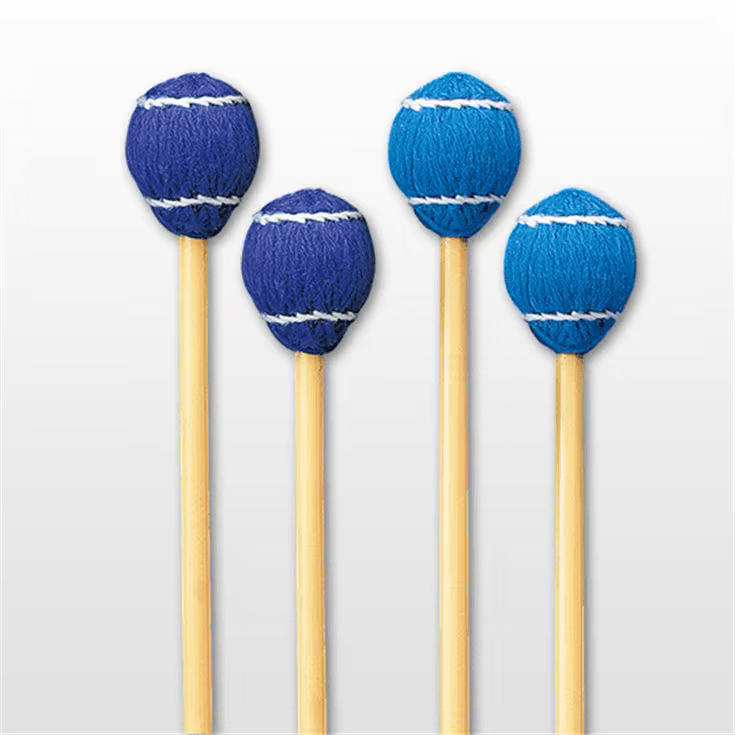
are also use where a lighter mallet is needed, but the roundness of a ball mallet is wanted. Barrel mallet heads, which are really egg-shaped more than barrel shaped, produce a very broad sound. Because of their large size, they often add weight to the mallet. Paired with a heavier set-up, they are good for producing an aggressive, full sound.
Mallet Wrappings
Wraps can be of yarn, cord, or rubber.. Yarn wrapping softens the contact sound and achieves a more legato, sustained sound. This wrapping is preferred for solo playing or in ensembles where the instrument should blend in. Tightly wound yarn wrapping allows for a clearer sound, whereas looser wrapping softens more and exaggerates the overtone mix. Yarn wrappings can wear quickly if used often, especially on vibraphone or cymbals.
Cord wrapping produces a brighter sound because it is harder and generally more tightly wrapped than yarn. Cord-wrapped mallets are good on marimba and vibraphone in ensembles because it produces a faster and clearer sound without having to use a harder mallet. Cord wrapping also wears more slowly than yearn.
Rubber is less often used as a wrapping material. One drawback to rubber is the noticeable contact sound that it makes; however, rubber wrapped mallets can be extremely useful when the instrument must be heard in a thickly orchestrated passage. In such cases, the contact noise is not noticeable.
Budget Buying Guide
Many band directors will not want or be able to buy a complete collection of mallets, covering all variations of core types, hardness, and wrappings. If your keyboard players have a medium vibraphone mallet with cord wrapping and a rubber core, this will work well for wind ensemble applications on vibraphone, marimba or even xylophone. It will produce clear articulation without going to a harder core. Also have heavy medium or medium-soft yarn wrapped mallets for use in ballads or in ensembles with thin orchestration. In general, it’s a good idea to by a variety of hardnesses and teach students when to use hard, medium or soft, depending on the orchestration and musical style.
Yamaha recommends yarn wrapped mallets for marimba, unwrapped plastic or metal mallets for glockenspiel, and cord-wrapped mallets for vibraphone. Xylophones do not have the sustain or resonance of marimbas or vibraphones, so the tone produced at the attack is especially important. Everything is staccato, so mallets should be selected that will immediately give the desired sound. In addition to hard mallets for bright, louder tones and soft mallets, such as rubber, to produce warmer, more rounded tones. Wooden mallets can also be a good choice, though one should employ them sparingly.
Teaching Suggestions
If there are gaps in your mallet collection, teach students how to play with differing touches to get brighter and darker sounds, so they can achieve something like what the missing mallets would allow. It will also teach them to be sensitive to the different timbres possible, and give them tools to improve their overall musicianship. This will enable them to intelligently select appropriate mallets, considering more than just hard for loud and soft for soft, which is sometimes as far as it goes. Providing mallets that are well suited to your repertoire and your instrumentation will result in better results and will serve as valuable learning tools for your students.
 mister a music place